

Lotus Shoes
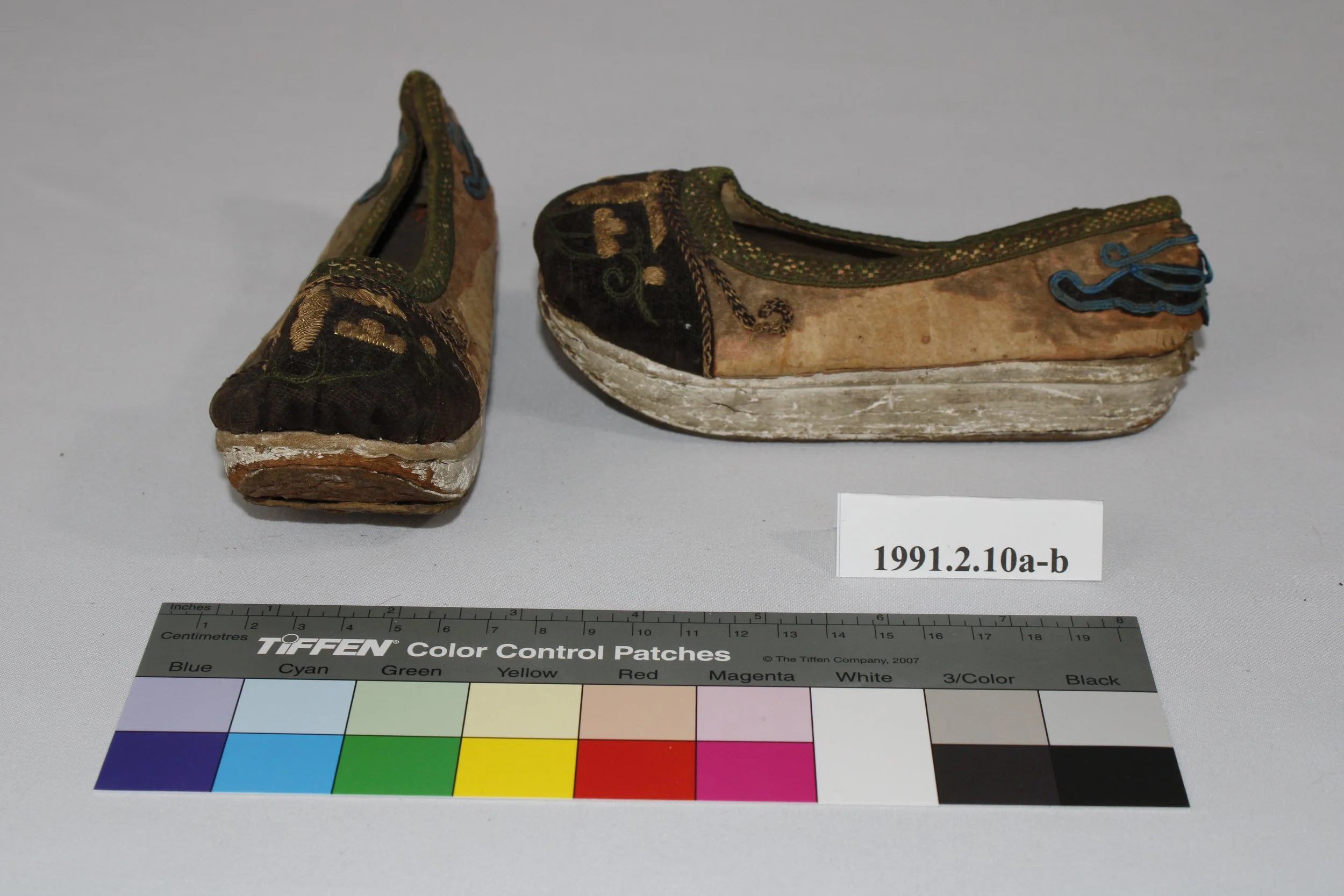
Lotus shoes found at the Ellwood House Museum
During my research on Chinese and Chinoiserie objects in the Ellwood House Museum collection, I was surprised and slightly horrified to stumble upon a pair of lotus shoes wrapped and buried in an unassuming gray box. At first, I was fascinated and instantly enamored by the object. Then a wave of guilt followed suit due to the horrific history of the item.
Lotus shoes, named after the lotus shape of the feet after it is bound, can be traced back to the Northern Song Dynasty (960 - 1127 AD) in China where it was mostly done by elite women. However, by Ming and Qing Dynasties (1368 - 1912 AD), foot-binding was practiced within commoners and the poor. The practice waned and gradually disappeared by the end of Imperial China, following the banning and punishing of those practicing foot-binding by the government of the Republic of China (Zhao et al. 2020).
The shoes housed in the Ellwood House Museum most likely took inspiration from the early stages of foot binding, where the alternation focused on making the foot straight and narrow rather than changing the shape of the arch. By the Ming Dynasty, foot-binding techniques evolved to deepen the arch of the foot. The ideal shape of bound feet with a straight profile and an “over-curved” arch came to be labeled as the “three-inch golden lotus” (Zhao et al. 2020). This shape was achieved by tightly binding the feet of young girls as young as 5 years old with binding cloth, forcefully bending the toes and breaking the arch of the foot after a few years of constant wear (Zhao 2024).
The idea of altering the foot was theorized to be caused by social mobility opportunities through marriage and the labor cost of women at the time. During the establishment of the Civil Examination System in Imperial China, men were able to climb the social ladder through academic performance. Women did not have that privilege and could only obtain social mobility through marriage. Thus, foot-binding aided women in securing such marriages as it fits the aesthetic preferences of the men as well as their moral preferences of domesticity and fidelity in their wives. Furthermore, deformities from foot-binding prevents women from doing intense labor and reduces them to work in sedentary activities such as household work (Fan and Wu 2020).
I believe the significance of the object and the story it tells regarding the history of China should not be buried in one of the boxes of the archival rooms. While the collecting of such an item is questionable, especially if it’s through personal fascination rather than public education, adding this item on display of the Ellwood House Museum can bring awareness to this often overlooked part of Imperial China. Further research on the effects of foot-binding in elderly Chinese women have been conducted in regards to long-term bone deformity (Zhao et al. 2020). However, more studies about this time in history can look into prevailing topics such as the intersectionality of race, class, and gender in evolving cultural aesthetics.
References:
Fan, Xinyu, and Lingwei Wu. 2020. “The Economic Motives for Foot-Binding.” https://www.wiwi.unibonn.de/bgsepapers/boncrc/CRCTR224_2020_187.pdf.
Zhao, Keyang . 2024. “Lotus Shoes – Mount Holyoke College Art Museum.” Mtholyoke.edu. March 11, 2024. https://artmuseum.mtholyoke.edu/blog/lotus-shoes-stories-chinese-women-and-american-women-missionaries/.
Zhao, Yongsheng, Lin Guo, Yuni Xiao, Yueming Niu, Xiaowen Zhang, Deliang He, and Wen Zeng. 2020. “Osteological Characteristics of Chinese Foot-Binding in Archaeological Remains.” International Journal of Paleopathology 28 (March): 48–58. https://doi.org/10.1016/j.ijpp.2019.12.003.